

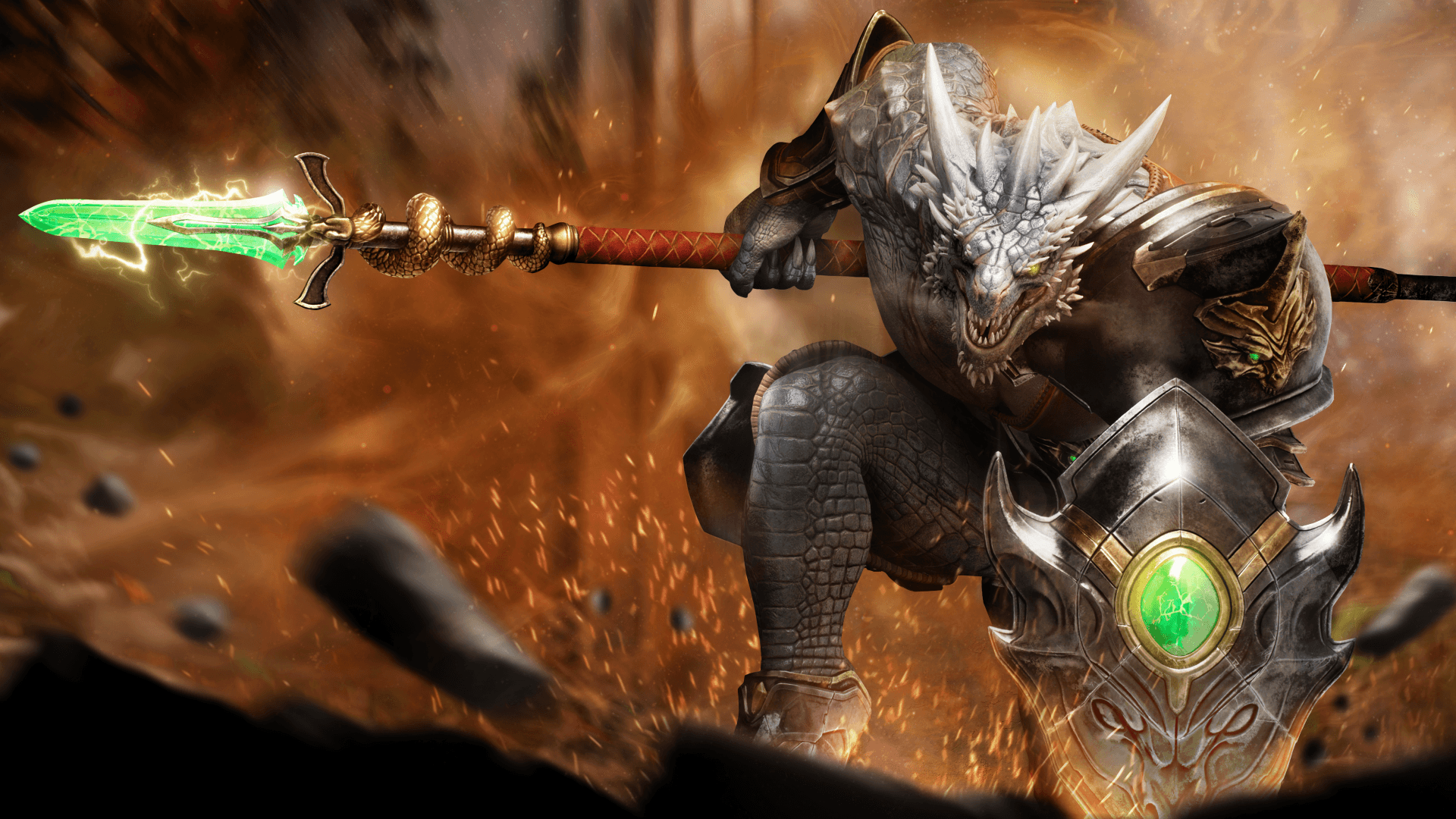
Ascension: The Champion of Nyr
Read More

Ascension: The Champion of Nyr
Some legends demand ceremony. Others kick down the vault door, burn the parchment, and scrawl themselves into the margins of memory. The latter is where we find Zarus - if that is even his first name, or merely a mask he adopted from the pages of myth.
Ah, but let us start properly - or as properly as this story allows.
In the steaming lowlands of Sylmara, among the moss-veiled roots of the marshlands, the Senezani tribe performed a sacred rite. Their leader placed a streak-marked egg - yellow and green, if the fragmentary altar paintings are to be believed - at the foot of the god-statue of Salazar. Three days of ritual followed. Fire. Chant. Blood, perhaps. The result: a golden glow upon the shell, faint, but recorded in both song and pigment. It was said this egg would one day bear a leader worthy of godhood.
Instead, it bore witness to annihilation.
The Nyrians came in force, armed and armoured, looking for bodies to break and carry back to their rising coliseum. They took the marshes. They took the Senezani. They took the eggs.
One among them, a purple-skinned Nyrian commander with a billowing pipe and a tasteless sense of décor, claimed the glowing egg and sealed it behind glass. For two years it sat - like a myth in a museum. Then one day, the shell cracked, and a small, blinking lizard sat amid the shards, staring at his reflection in a case of polished brass.
And here - here - the tale begins to lean toward the unbelievable. Yet the documents exist. Testimonies, carvings, even a Nyrian ledger with the phrase “small reptilian ward, hatched in residence” scribbled in the margins. Our world is too strange to dismiss the improbable out of hand.
The lizardling, smaller than the others, was cast into the same grim upbringing as his kin. Servitude, lashings, hauling stone beneath the rising monolith of Nyr’s coliseum. His peers mocked him. He fought them. And more often than not, he won.
But fighting was not all. He traded scraps for books - stories from across Sylmara. Languages. Folklore. And in one thin, moth-eaten volume he found the tale of another lizard: Zarus, a mortal who endured suffering so profound the gods themselves took notice and granted him divinity. Perhaps it was just a tale. Perhaps not. But from that day onward, he was Zarus.
Now, allow me a tangent - as is my privilege as an archivist of historical secrets. Do you believe a name can shape a soul? Not merely in the symbolic sense, but in the structural? The idea that belief - especially self-belief, forged under pressure - can crystallize into fate? I have seen stranger things.
Regardless, Zarus trained. He fought. And when the slaves created a secret night-ring to test each other, he rose through its ranks until only one remained. He lost the final bout, they say - barely - but made himself known.
And this is where the record sharpens.
The Nyrian commander, ever suspicious and quite bored by peace, discovered the ring. He stormed down to the hidden fighting pit, demanded to know the winner. And every trembling finger pointed to the smallest among them.
Appalled, and perhaps intrigued, the commander tossed Zarus a spear and challenged him on the spot. Zarus, still bleeding from his earlier match and unfamiliar with the weapon, did not hesitate.
They fought.
Now, here is where I must admit something: I do not like this part of the story. Not because it lacks beauty - quite the opposite - but because it hurts the myth. Zarus loses. The commander is too skilled, too cruel, too well-fed. He breaks Zarus’ guard and, with a single stroke of that damned ornate glaive, he takes his eye. Just like that. No glory. No trick. Just blood on the sand.
The fighting ring was dissolved.
But then something unexpected.
The commander, for reasons lost to time - boredom? pride? something stranger? - visits Zarus in his cell. He offers him a pact: train under him, become a fighter worthy of spectacle, and the commander will wager on him when the coliseum opens. There is one condition: for every loss, Zarus must earn another scar, and take another beating from the man who took his eye.
And Zarus agrees.
He trains every night. Learns forms. Weapons. Rhythm. All under the same hand that maimed him. I find this... maddening. And yet, it aligns with the mythic pattern. Descent before ascent. Shackles before wings.
For ten years, Zarus fights in the coliseum, losing only three times. Three scars. Three lessons. But as public interest wanes, the rules shift. Death matches. A year-long circuit. And the prize? Glory. Wealth. And freedom - if the champion was a slave.
Zarus wins. Of course he does. The gods wouldn’t have it otherwise.
But the Nyrian government, ever disdainful of the Senezani and unprepared for a lizard crowned in laurels, responds with betrayal. They send soldiers. An execution squad, dressed in pageantry. Zarus, predictably, responds with vengeance.
They say he cut down every soldier sent to kill him. They say his wounds closed as quickly as they opened. They say he strode through the blood-wet corridors of the coliseum until he stood before the King of Nyr, and with a single spear-thrust, ended a dynasty.
But here's my favourite part - and perhaps the most true of all, for no artist would dream it:
They say he held the crown. Looked at it. Weighed it in his hand. Then threw it into the air and shattered it with a spear, sending purple gems and twisted gold across the arena floor like so much trash.
He did not stay to be king. He left. Into the wilds. Toward something greater.
Now, whether Zarus seeks ascension, or simply an enemy worthy of the story he’s written into himself, I do not know. But I do know this:
I believe in him.
Echo Seeker Niborius